
Updated September 7, 2026
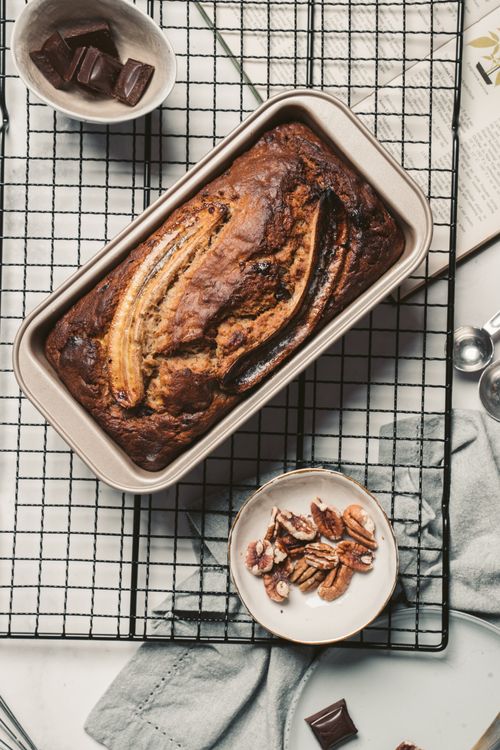
If your banana bread rises beautifully in the oven and then sinks in the middle, turns gummy near the center, or comes out dry around the edges, altitude may be the missing piece. At elevations above roughly 3,000 feet, lower atmospheric pressure changes how quickly gases expand and how quickly moisture leaves the batter. That means a sea-level banana bread recipe can behave very differently in Denver, Santa Fe, Salt Lake City, Flagstaff, or another mountain kitchen.
The good news is that high altitude banana bread does not require guesswork. The most useful changes are surprisingly simple: control the amount of baking soda and baking powder, compensate for faster moisture loss, strengthen the batter enough to hold its rise, and make sure the oven sets the crumb before the expanding gases get ahead of it.
This guide takes a different approach from generic altitude charts. Instead of treating every banana bread recipe as if it needs the same correction, it shows you how to think about the relationship between bananas, liquid, flour, sugar, leavening, pan size, and oven heat. That matters because a very ripe banana-heavy loaf behaves differently from a drier, cake-like quick bread.
Quick answer: For banana bread around 5,000 to 7,000 feet, start by reducing chemical leavening, adding a modest amount of liquid, slightly strengthening the batter with flour, and using a somewhat hotter oven. Do not automatically make every adjustment at once if you are converting a recipe that already works reasonably well at your elevation. High-altitude baking is recipe-specific, and changing one variable at a time makes troubleshooting much easier.
Why Banana Bread Fails at High Altitude
High-altitude baking is not really about the mountain itself. It is about what the thinner atmosphere does to the ingredients inside the oven.
Colorado State University Extension notes that atmospheric pressure falls as elevation increases. At sea level, water boils at about 212°F; at 5,000 feet it boils at roughly 203°F, and at 10,000 feet it is about 193°F. The same lower pressure also allows leavening gases to expand more rapidly. [Colorado State University Extension's high-elevation food preparation guide](https://extension.colostate.edu/resource/high-elevation-food-preparation-guide/?utm_source=chatgpt.com)
1. The batter can rise faster than its structure can set
Baking soda and baking powder create carbon dioxide. Steam also contributes to expansion. At higher elevations, those gases expand more readily because atmospheric pressure is lower.
That sounds helpful until the batter rises faster than the flour, starches, proteins, and eggs can form a stable structure. The loaf can look spectacular halfway through baking, only to collapse when the expanding gases escape.
This is why more leavening is usually not the answer to a flat high-altitude loaf. The problem may be that the loaf is already rising too aggressively and simply cannot hold the expansion.
2. Moisture leaves the batter faster
Lower atmospheric pressure also changes evaporation. Water reaches its boiling point at a lower temperature, and moisture can escape more readily during baking. A banana bread batter that has exactly enough liquid at sea level may therefore finish drier at altitude.
This is particularly important with banana bread because bananas contribute a large amount of water, sugar, fiber, and starch. Two batches made from different bananas can therefore behave differently even when every other ingredient is weighed exactly the same.
3. Sugar can become part of the structural problem
Sugar does much more than make banana bread sweet. It attracts water and interferes with structural setting. When evaporation is already faster, excessive sugar can contribute to a loaf that stays soft in the center while the outside becomes increasingly dark.
That does not mean high-altitude banana bread should taste unsweet. Very ripe bananas are useful here because they bring concentrated banana flavor and sweetness without requiring you to solve the problem by simply adding more granulated sugar.
4. Flour provides the framework
When gases expand rapidly, the batter needs enough structure to contain them. A modest increase in flour can help, but more flour is not automatically better. Too much turns banana bread from moist and tender into heavy and dry.
The goal is not to make a stiff batter. The goal is to create a batter strong enough to rise and then stay where it lands.
The Most Important High Altitude Adjustments
There is no universal correction that works perfectly at every elevation. King Arthur Baking describes high-altitude adjustments as a starting point because altitude, recipe composition, oven behavior, and local conditions all interact. Its general guidance includes reducing leavening, increasing liquid, modestly reducing sugar, adding flour, and increasing oven temperature. [King Arthur Baking's high-altitude baking guide](https://www.kingarthurbaking.com/learn/resources/high-altitude-baking?utm_source=chatgpt.com)
| Elevation | Starting approach | What to watch for |
|---|---|---|
| Below 3,000 ft | Usually use the original recipe | Focus on normal banana moisture and oven accuracy |
| 3,000–5,000 ft | Make small leavener and liquid adjustments | Watch for excessive rise and a dry crumb |
| 5,000–6,500 ft | Reduce leavening more noticeably and add modest liquid | Center collapse and over-browning |
| 6,500–8,000 ft | Use stronger structural support and carefully controlled leavening | Rapid rise followed by sinking |
| Above 8,000 ft | Use smaller, incremental adjustments and test carefully | Drying, uneven baking, and structural collapse |
Utah State University Extension similarly recommends reducing chemical leavening for quick breads and using additional liquid where needed at altitude. [Utah State University Extension's high-altitude baking guidance](https://extension.usu.edu/archive/adjusting-for-high-altitude-baking?utm_source=chatgpt.com)
Before You Change the Recipe, Check Your Bananas
This is one of the most overlooked variables in banana bread.
A recipe that says “3 bananas” is not actually specifying a consistent amount of banana. One baker may use three small bananas totaling 300 grams, while another may use three very large bananas totaling 450 grams. That difference can radically change the moisture and sugar balance of the batter.
For reliable high-altitude baking, weigh your mashed bananas.
- Use heavily speckled or brown bananas for the strongest flavor.
- Measure the mashed banana by weight rather than counting bananas.
- If your bananas are unusually large and wet, do not automatically add every other liquid in the recipe.
- If your bananas are small or relatively dry, the batter may need more milk or buttermilk.
- Do not assume that “more banana” always means “better banana bread.” Excess banana can leave the center heavy and wet.
This banana-weight approach is one of the simplest ways to make altitude troubleshooting more repeatable.
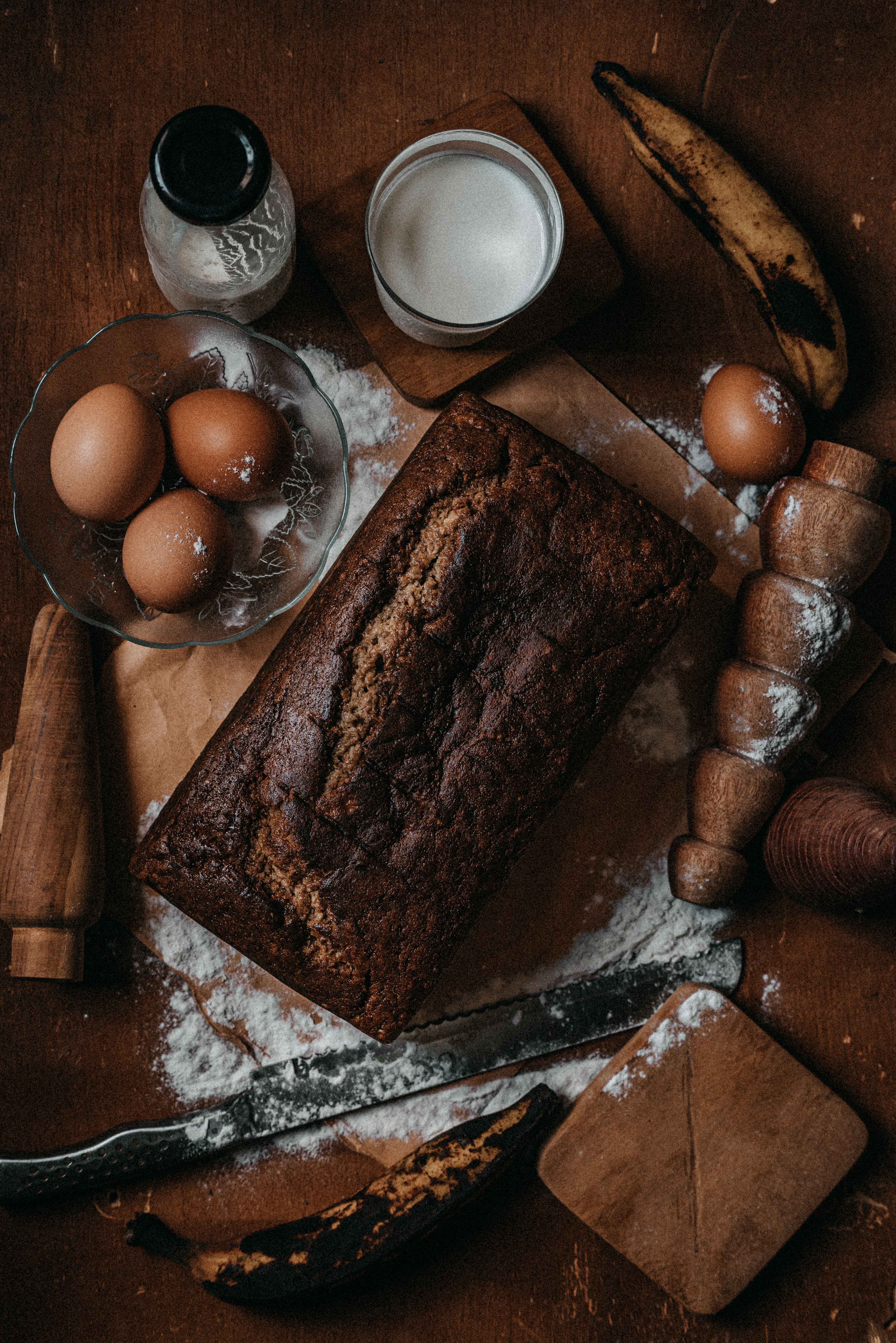
High Altitude Banana Bread Recipe for 5,000 to 7,000 Feet
This version is designed as a practical starting point for the middle-to-high elevation range rather than as a claim that one formula will perform identically in every mountain kitchen. If your oven or local conditions differ, use the troubleshooting section to make one adjustment at a time.
Ingredients
- 220 g all-purpose flour
- 1/2 teaspoon baking soda
- 1/4 teaspoon baking powder
- 1/2 teaspoon fine salt
- 1/2 teaspoon ground cinnamon
- 113 g unsalted butter, softened
- 135 g granulated sugar
- 2 large eggs, preferably at room temperature
- 340–350 g very ripe mashed banana
- 95 ml whole milk or buttermilk
- 1 teaspoon vanilla extract
- 1 tablespoon plain yogurt or sour cream
- 3/4 cup chopped walnuts, pecans, or chocolate chips, optional
Pan: One 9 x 5-inch light-colored metal loaf pan.
Oven: Start at 365°F (185°C) for approximately 5,000–7,000 feet. If your oven browns aggressively, reduce the temperature slightly rather than allowing the crust to burn while the center remains underdone.
Step 1: Prepare the oven and pan
Place a rack in the center of the oven and preheat to 365°F. Grease the loaf pan and line it with parchment, leaving enough paper over the long sides to lift the baked loaf out later.
An inexpensive oven thermometer is particularly useful at altitude. If the oven display says 365°F but the actual cavity is running at 385°F, your altitude adjustments can appear to be failing when the real problem is temperature accuracy.
Step 2: Mix the dry ingredients
Whisk together the flour, baking soda, baking powder, salt, and cinnamon.
Because the leavening quantity is deliberately controlled, distribute it thoroughly through the flour. Unevenly dispersed baking soda can produce isolated pockets of excessive rise or an unpleasant alkaline taste.
Step 3: Cream the butter and sugar
Beat the softened butter and sugar for about two minutes, until smooth and somewhat fluffy.
Do not chase maximum volume. At altitude, you are trying to create enough aeration for a pleasant crumb without building a batter that depends on a huge amount of trapped air to stay upright.
Step 4: Add the eggs and wet ingredients
Add the eggs one at a time. Mix in the mashed banana, milk, vanilla, and yogurt or sour cream.
The mixture may look slightly uneven or curdled at this point. That is not a problem.
Step 5: Combine wet and dry ingredients
Add the flour mixture in two additions. Fold gently until no obvious dry flour remains.
Stop mixing as soon as the batter comes together. A few small streaks that disappear with the final fold are preferable to aggressively mixing the batter smooth.
Step 6: Add optional mix-ins
Fold in the walnuts, pecans, or chocolate chips.
If using chocolate chips or nuts, lightly coating them with a small amount of the measured flour can help distribute them more evenly through the batter.
Step 7: Bake
Transfer the batter to the prepared pan and smooth the top.
Bake for approximately 55 to 70 minutes, beginning to check around 50 minutes. The exact time depends on the pan, oven, batter temperature, banana moisture, and elevation.
Do not rely on the clock alone. A toothpick should emerge with moist crumbs rather than liquid batter. An instant-read thermometer can provide another useful data point; aim for roughly 200–205°F (93–96°C) in the center while remembering that thermometer placement and recipe composition affect the reading.
Step 8: Protect the top if it browns too quickly
If the crust becomes dark while the center still needs time, loosely tent the loaf with foil. Do not press the foil against the batter.
Step 9: Cool completely
Let the bread rest in the pan for about 15 minutes, then lift it onto a rack and allow it to cool thoroughly before slicing.
This is not just a patience test. The crumb continues to stabilize as the loaf cools. Slicing a very hot banana bread can make a properly baked loaf appear wetter and gummier than it actually is.
What to Change at Different Elevations
At 3,000 to 4,500 feet
Start conservatively. Many quick breads remain fairly resilient in this range. Reduce the leavener modestly if your loaf rises too quickly, and add liquid only if the finished bread is drying out.
Do not make five changes simultaneously simply because a chart says you can. If the loaf already works, small changes are more informative.
At 5,000 to 6,500 feet
This is the range where the classic high-altitude problems become more obvious. Begin with controlled leavening, a modest increase in liquid, and enough flour to support the batter. A moderately hotter oven can help the structure set before the loaf over-expands.
King Arthur Baking's leavener chart shows increasingly larger reductions as elevation rises, but also emphasizes that the numbers are starting points rather than universal rules. [King Arthur's leavener adjustment guidance](https://www.kingarthurbaking.com/learn/resources/high-altitude-baking?utm_source=chatgpt.com)
At 6,500 to 8,000 feet
Pay particular attention to baking soda and baking powder. A loaf that shoots upward and then sinks is usually telling you that its expansion outran its structural setting.
Make changes incrementally. If you reduce both leaveners dramatically, add a large amount of flour, and raise the oven temperature at the same time, you may fix one problem while creating another.
Above 8,000 feet
Very high elevations deserve a more experimental approach. Smaller loaf pans can sometimes make the center easier to bake before the exterior becomes excessively dark. You may also need to reduce chemical leavening further and compensate for increased evaporation.
At these elevations, keeping notes becomes surprisingly valuable. Record the elevation, actual oven temperature, banana weight, batter weight, pan size, bake time, and result. Your own kitchen data can become more useful than a generic altitude chart after several successful batches.
The New Rule for High Altitude Banana Bread: Control the Banana-to-Liquid Balance
Most altitude guides focus on flour, sugar, liquid, and leavening as separate variables. For banana bread, there is another relationship worth watching: how much banana moisture enters the batter compared with the amount of added liquid and flour available to absorb it.
That is why two people at exactly 6,000 feet can use the same recipe and get different results.
Imagine one baker uses 330 grams of mashed bananas and another uses 430 grams. The second batter may have substantially more moisture and sugar even though both bakers followed the instruction “use three bananas.” Adding extra milk because a generic altitude chart recommends it could make the wetter batch even more prone to a gummy center.
A better approach is to treat the recipe as a balance:
- Banana provides moisture, sugar, starch, and flavor.
- Milk or buttermilk provides additional moisture and tenderness.
- Flour provides structural support.
- Eggs help bind and set the crumb.
- Leaveners create expansion.
- Heat determines how quickly that structure sets.
Altitude changes the speed of several of these processes at once. The best recipe therefore is not the one with the most aggressive correction. It is the one where the expansion, moisture, and structural setting finish at roughly the same time.
Why Your Banana Bread Sank in the Middle
A sunken center is the most recognizable high-altitude banana bread failure, but the cause is not always identical.
Too much leavening
The loaf rises dramatically, the internal bubbles become too large, and the structure cannot hold them once the baking process slows. Reduce the baking soda or baking powder slightly on the next attempt.
Too much liquid
Extra liquid can help at altitude, but excessive moisture can leave the center unable to set. Look at your banana weight before automatically adding more milk.
Too much sugar
Excess sugar can weaken the structure and contribute to a soft center. If your loaf repeatedly collapses while remaining very moist, test a modest sugar reduction.
Oven temperature is too low
If the batter spends too long expanding before its structure sets, the loaf may rise and fall. Verify the oven temperature with a thermometer before changing several ingredients.
The loaf was removed too early
A clean-looking crust does not guarantee a finished center. If the middle is wet or collapses shortly after removal, give the next loaf more time and use an internal temperature reading alongside visual tests.
If the Center Is Gummy
High-altitude banana bread can have a naturally moist crumb without being underbaked. The distinction is important.
A moist crumb springs back when pressed and holds together when sliced. An underbaked center looks pasty, compresses easily, and may leave wet batter-like residue on a knife.
Try these checks:
- Weigh the bananas instead of counting them.
- Verify the oven temperature.
- Use a light-colored metal loaf pan if the crust is darkening too quickly.
- Bake longer rather than simply raising the temperature dramatically.
- Tent the top if necessary.
- Allow the loaf to cool fully before judging its final texture.
If Your Banana Bread Is Dry
Dryness is often blamed on altitude alone, but flour measurement and oven accuracy are equally important.
Weigh the flour. If you do not have a scale, spoon it lightly into a measuring cup and level it rather than scooping directly from the flour container.
Then check whether your oven is running hot. A 20°F temperature error can matter when you are already using a higher baking temperature to compensate for altitude.
If the recipe is otherwise structurally sound, add a small amount of liquid or banana rather than making a large correction. High-altitude baking rewards small experiments.
If the Top Is Dark but the Middle Is Raw
This is a classic sign that the outside is receiving heat faster than the center can finish setting.
Use a light-colored metal pan, move the rack to the center, and tent the loaf once the crust reaches the color you want. Avoid simply lowering the temperature dramatically without considering the altitude-related need for the structure to set.
If the Loaf Is Dense
Dense banana bread can result from too much flour, under-mixing of the leavening, insufficient chemical leavening, overmixing, or excessive banana relative to the structural ingredients.
Start with the simplest checks. Weigh your ingredients. Make sure your baking soda and baking powder are fresh. Then examine the batter consistency before changing the formula.
Why a Big Crack on Top Is Not Automatically a Failure
A crack running along the top of banana bread is often completely normal. As the outside of the loaf sets, the still-expanding interior can push through the surface.
The important question is whether the crack is accompanied by a structural problem. A moderate crack with an evenly baked interior can be a sign of a healthy loaf. A dramatic dome followed by a sunken center is a different story.
Chocolate Chip High Altitude Banana Bread
Fold in approximately 3/4 cup chocolate chips after the batter has been mixed.
Mini chips distribute particularly well. If using large chips, avoid adding excessive amounts because heavy mix-ins can change how the batter rises and can make the center feel heavier.
High Altitude Banana Walnut Bread
Add 3/4 cup chopped walnuts or pecans. Toasting the nuts first adds more flavor without requiring additional sugar.
If the nuts are very large, chop them into smaller pieces so they distribute through the batter instead of forming heavy pockets.
Whole Wheat High Altitude Banana Bread
Replace up to half of the all-purpose flour with white whole wheat flour. Whole wheat flour generally absorbs more water, so you may need additional liquid.
Add the extra liquid gradually rather than automatically adding the full amount recommended for a standard high-altitude conversion.
Gluten-Free High Altitude Banana Bread
Use a reliable 1-to-1 gluten-free baking blend designed for cakes and quick breads. Because gluten-free formulas do not develop the same gluten network as wheat flour, structural adjustments become even more important.
Do not assume that a wheat-based altitude correction can be transferred directly to a gluten-free formula. The blend, starch content, gums, and hydration level can all change the result.
Vegan High Altitude Banana Bread
For a vegan version, replace the eggs with an appropriate egg substitute and use plant-based butter or neutral oil. Because eggs contribute to the final structure as well as moisture, a vegan high-altitude loaf may need more structural support than the standard version.
Test the substitute in a small batch before making large altitude corrections. The egg replacement itself may be the dominant variable.
Does Pan Material Matter at High Altitude?
Yes, particularly when the recipe already calls for a hotter oven.
Dark pans absorb and transfer heat differently from light-colored metal pans. Glass also behaves differently from metal. If your loaf consistently develops a very dark crust before the center is ready, changing the pan may solve the problem more effectively than repeatedly changing the recipe.
Pan size matters too. A batter that is too deep takes longer for heat to reach the center. At very high elevations, splitting a large batch into two smaller loaves can sometimes produce a more predictable result.
How to Store High Altitude Banana Bread
Once completely cool, wrap the loaf tightly or place it in an airtight container.
- Room temperature: Best for short-term storage when the kitchen is cool and dry.
- Refrigerator: Useful for longer storage, although refrigeration can make bread seem firmer and less fresh.
- Freezer: Slice the cooled loaf, wrap portions well, and freeze for convenient individual servings.
Dry mountain air makes good wrapping especially important. A loaf can lose moisture noticeably faster when exposed to dry air.
Frequently Asked Questions About High Altitude Banana Bread
What altitude is considered high altitude for baking?
For baking purposes, high altitude is commonly treated as beginning around 3,000 to 3,500 feet above sea level. The exact point at which adjustments become necessary depends on the recipe and local conditions.
Why does banana bread sink at high altitude?
The most common reason is excessive expansion before the internal structure has set. Too much leavening, excessive liquid or sugar, insufficient structural support, and an oven that is too cool can all contribute.
Should I reduce baking soda for high altitude banana bread?
Usually, yes, but the exact amount depends on elevation and the recipe. High-altitude guidance generally recommends reducing chemical leavening because gases expand more rapidly under lower atmospheric pressure.
How much extra liquid should I add to banana bread at high altitude?
Start modestly. General high-altitude guidance commonly recommends additional liquid beginning around 3,000 feet, with progressively larger adjustments at greater elevations. For banana bread, account for the actual amount and moisture of your mashed bananas before adding extra milk.
Should I increase the oven temperature for banana bread at high altitude?
Often, yes. A moderately higher oven temperature can help the loaf's structure set before the batter over-expands. However, the correct temperature depends on the pan, oven accuracy, recipe, and elevation.
Why is my high altitude banana bread wet in the middle?
The loaf may need more baking time, or the batter may contain too much moisture relative to its structural ingredients. Check the banana weight, flour measurement, oven temperature, and pan size before making major recipe changes.
Can I use a normal banana bread recipe at high altitude?
Yes. Quick breads can be relatively resilient at altitude, and some recipes may need only minor adjustments. Colorado State University Extension notes that quick breads vary in structure and that cake-like versions are generally more sensitive than sturdier muffin-style quick breads. [Colorado State University Extension's quick-bread guidance](https://extension.colostate.edu/resource/high-elevation-food-preparation-guide/?utm_source=chatgpt.com)
Is 5,000 feet high enough to change banana bread?
Yes. At 5,000 feet, atmospheric pressure is substantially lower than at sea level, and the boiling point of water is around 203°F. That can affect evaporation and the expansion of leavening gases.
Can I bake banana bread at 10,000 feet?
Absolutely, but expect to experiment more carefully. At very high elevations, small changes in leavening, hydration, flour, pan size, and oven temperature can have a noticeable effect.
Why does my banana bread taste bitter after altitude adjustments?
Too much baking soda can leave an alkaline or bitter taste. If you have reduced the acidic ingredients while keeping the same amount of baking soda, the imbalance can become even more noticeable.
Should I use very ripe bananas for high altitude banana bread?
Yes. Very ripe bananas generally provide stronger flavor and natural sweetness. More importantly, weigh the mashed bananas so the amount of moisture entering each batch is consistent.
The High Altitude Banana Bread Troubleshooting Checklist
| Problem | First thing to check | Next adjustment to test |
|---|---|---|
| Center collapses | Too much leavening or insufficient setting | Reduce leavener slightly or increase structural support |
| Center is gummy | Banana moisture, bake time, oven temperature | Bake longer and verify ingredient weights |
| Loaf is dry | Flour quantity and oven temperature | Add a small amount of liquid or reduce bake time |
| Top burns first | Pan and actual oven temperature | Tent with foil or change pan material |
| Loaf is very dense | Flour weight and mixing | Check flour measurement and leavening distribution |
| Huge dome then collapse | Excessive gas expansion | Reduce chemical leavening |
| Flat flavor | Reduced sugar and underripe bananas | Use riper bananas, vanilla, cinnamon, or toasted nuts |
| Uneven crumb | Uneven mixing or excessive mix-ins | Mix gently but distribute leavening thoroughly |
The Best Way to Convert Any Banana Bread Recipe for Altitude
If you already have a favorite banana bread recipe, do not throw it away. Convert it systematically.
- Record your exact elevation. “Mountain town” is not precise enough.
- Weigh the bananas. This removes one of the biggest sources of batch-to-batch variation.
- Weigh the flour. Do not let an inconsistent cup measurement hide the real problem.
- Check your oven temperature. Use an oven thermometer.
- Reduce chemical leavening modestly. Use a reputable altitude chart as your starting point.
- Increase liquid only as needed. Remember that bananas already contribute significant moisture.
- Consider a small flour increase. The goal is structural support, not a stiff batter.
- Use a moderately higher baking temperature if appropriate.
- Change one variable at a time after the first adjustment.
- Write down the result. Your successful batch becomes the best reference for your kitchen.
This method is more useful than blindly applying every number on a generic altitude chart. King Arthur Baking and university extension guidance both emphasize that altitude adjustments are starting points and that different recipes can require different solutions. [King Arthur Baking's altitude adjustment guide](https://www.kingarthurbaking.com/learn/resources/high-altitude-baking?utm_source=chatgpt.com)
What the Science Really Means for Your Next Loaf
The central lesson is simple: high altitude does not ruin banana bread; it changes the timing of the chemistry.
The batter rises sooner. Moisture leaves faster. The boiling point of water drops. Sugar can affect structure differently. And the loaf has less time to establish its internal framework before expansion gets ahead of it.
That is why the best high-altitude banana bread is built around balance rather than one magic ingredient adjustment.
Reduce excessive expansion. Preserve enough moisture. Give the batter enough structure. Set that structure at the right moment. Then let the loaf cool before judging it.
Once you start weighing bananas and flour, checking your actual oven temperature, and recording what happens at your specific elevation, high-altitude banana bread becomes much less mysterious. You stop fighting the mountain and start baking for the conditions in front of you.
The Bottom Line
If your banana bread keeps collapsing, drying out, or turning gummy above 3,000 feet, do not assume you need an entirely different recipe. Start with the fundamentals: less chemical leavening, enough but not excessive liquid, adequate structural support, and an oven temperature that allows the crumb to set before the loaf over-expands.
For the 5,000–7,000-foot range, the recipe in this guide gives you a practical starting point. But the most reliable adjustment is ultimately the one that matches your elevation, your bananas, your pan, and your oven.
And that is the part generic recipes often leave out: at high altitude, your kitchen is not a failed version of a sea-level kitchen. It is a different baking environment, and once the recipe is calibrated to that environment, a tall, moist, deeply banana-flavored loaf is absolutely achievable.
Further Reading and High Altitude Baking Sources
- Colorado State University Extension: High Elevation Food Preparation Guide
- King Arthur Baking: High-Altitude Baking Guide
- Utah State University Extension: Adjusting for High Altitude Baking
- King Arthur Baking: High-Altitude Banana Bread Recipe
Recipe and adjustment guidance should be treated as a practical starting point rather than a guarantee for every oven or elevation. High-altitude baking varies with atmospheric conditions, recipe composition, pan material, ingredient weights, and oven accuracy. For best results, make controlled changes and keep notes on successful batches.
