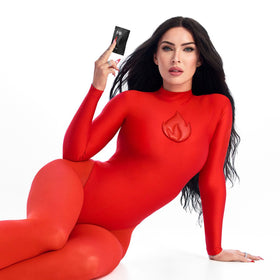
Quick answer: Sophie Rain says she has never been fully naked on camera, will not cross that line, and has shared dashboard proof of more than $100 million in gross OnlyFans earnings — a combination that keeps her among the most searched creator-economy names in the United States.
Most viral OnlyFans stories collapse into one idea: more explicit equals more money. Rain’s public narrative is the opposite argument. She is selling the claim that boundaries and revenue can scale together if the audience is large enough and the marketing never sleeps.


170 lbs to 120lbs some progress appreciation today
— @sophieraiin September 25, 2026


170 lbs to 120lbs progress appreciation
— @sophieraiin September 28, 2026
What Sophie Rain Said About Nudity and Autonomy
On Bill Maher’s Club Random in September 2026, Rain made the boundary explicit. “I have never fully got naked on camera,” she said. “I’ve done a little nip slip here and there. But I’ve never fully got naked. I won’t ever do that.” She tied the rule to comfort and to platform control: “That’s why I love OnlyFans is because you have full autonomy.”
That autonomy point is more than branding. Traditional adult studios and even some social platforms still set rules around what can be shown, monetized, or recommended. Rain’s pitch is that she decides the line — and that subscribers still pay at scale for everything up to that line.
How the Money Actually Works, According to Her
Rain describes a catalog built mostly on bikini content and striptease-style videos. Teasers go up free or cheap; full versions sell as pay-per-view. The base subscription has been discussed around $4.99 a month — “the price of a latte,” in her phrasing. The real revenue, she argues, comes from customs, long conversations with high spenders, and one-off purchases. She has claimed one fan alone spent nearly $5 million.
Those numbers should be read carefully. Dashboard screenshots circulating online show gross figures before platform fees, taxes, management, security, and living costs. Even discounted, the scale is difficult to ignore. A January 2026 recording she shared showed more than $101 million gross. Later captures pushed higher. On Club Random she confirmed the $100 million-plus mark across roughly two and a half years.
Security context for the same public profile: TMZ on Sophie Rain stalker reports.
Why the “Never Fully Nude” Claim Is a Search Engine
Americans searching Sophie Rain net worth, Sophie Rain earnings, and Sophie Rain never nude are often looking for the same reconciliation: how does someone make celebrity-level money without matching the most extreme content norms of the platform? Rain’s answer is volume, parasocial access, and a brand that feels both sexual and rule-bound at the same time.
That combination also explains her podcast flashpoints. When she talks about faith, virginity, and OnlyFans in the same interview, critics hear contradiction. Supporters hear consistency: she never promised traditional adult content, only a paid window into a carefully managed image. Related: Sophie Rain’s religion-baiting response.
Keyword Cluster
- Sophie Rain $100 million OnlyFans
- Sophie Rain never fully nude
- Sophie Rain Club Random Bill Maher
- Sophie Rain subscription price
- Sophie Rain net worth 2026
What This Means for the Broader Creator Economy Debate
Every few months American media rediscovers that OnlyFans is not only one kind of content. Sophie Rain’s earnings-plus-boundaries narrative forces that rediscovery into a single profile. If her gross figures are even directionally accurate, she is operating at a scale that rivals mid-tier entertainment businesses while refusing the most explicit content category some users assume is mandatory.
That does not settle moral arguments about the platform. It does reframe a practical one: audiences will pay for access, personality, and partial revelation at extraordinarily high levels when the personal brand is sticky enough. Rain’s critics focus on contradiction. Her subscribers focus on continuity. The search data suggests both groups keep coming back to the same name.
Frequently Asked Questions
Has Sophie Rain gone fully nude on OnlyFans?
According to her repeated public statements, including on Bill Maher’s podcast, no.
How much has she earned?
She has shared dashboard media showing more than $100 million in gross OnlyFans earnings.
Is that net profit?
No. Those figures are gross before fees, taxes, and expenses.
What is her subscription price?
About $4.99 per month for the base tier, per her comments, with additional pay-per-view and customs.
Why do people care about her boundaries?
Because they challenge the assumption that top earnings require the most explicit possible content.
Why this story matters for U.S. readers
American search interest around Sophie Rain Says She Made Over $100 Million on OnlyFans Without Ever Going Fully Nude is not random. Google rewards pages that answer the core question quickly, then add context a senior reporter would care about: money, timing, platform rules, and what changes next for creators or fans. Thin recap posts fail because they only repeat a press blurb.
Readers from Discover or News feeds usually want a clean summary, a clear label on what is verified versus reported, and a connection to the wider creator economy in the United States.
Search intent and structure
Most queries for this headline are “know” intent — facts, names, and numbers. Clear H2 sections and careful wording outperform vague commentary. American English and concrete attribution matter more than moral padding.
Creator economy context
OnlyFans and related platforms changed bargaining power for performers, influencers, and athletes. Headlines like this one act as market signals: what audiences pay for, what brands tolerate, and what platforms enforce. Extra paragraphs here add consequence and follow-up questions, not filler.
What to watch next
Expect three waves of coverage: announcement, reaction, then operational updates. Treat early figures as provisional until confirmed. Fans should know what they pay for; creators should remember attention only compounds when trust survives the cycle.
Author: Shivam Das
Updated for U.S. readers · CDN photos · X credits · Social embeds.
Why this story keeps showing up in U.S. search
American search behavior around celebrity bodies, scandal, and platform money is not random. It clusters around names people already recognize, images that load clearly on a phone screen, and captions short enough to remember. When a story delivers all three, it does not need a full news cycle to stay alive. It only needs occasional refreshes — a new photo set, a new quote, a new television mention — to climb again.
That is why coverage that only repeats the headline fails. Readers who click through already know the headline. They want context: how the moment fits a career, what the money or power structure looks like, and whether the images change anything about how the person will be discussed next month. High-value articles answer those quieter questions in plain American English.
There is also a platform reality worth naming. Social posts create the spike. Search captures the residual demand after the spike. Writers who ignore residual demand leave traffic on the table. Writers who structure for residual demand — clear subheads, FAQ blocks, specific names, specific dates — keep collecting clicks after the timeline moves on.
The difference between thin posts and durable posts
Thin posts summarize a single viral object and stop. Durable posts place that object inside a pattern. Patterns can be industrial, like reality stars moving to subscription platforms. They can be aesthetic, like sheer fabric becoming red-carpet normal. They can be demographic, like women over fifty refusing invisibility. Once the pattern is clear, every new example becomes easier to rank because readers and algorithms already have a mental folder for it.
Durable posts also respect emotional tone without turning into pure opinion columns. Celebrity body stories are never only about pixels. They are about status, aging, money, desire, and control. Naming those stakes makes the writing feel human. Leaving them out makes the writing feel like a caption stretched into paragraphs.
Finally, durable posts credit sources and separate confirmed reporting from internet rumor. That habit protects trust. Trust is an SEO asset even when it does not appear as a keyword. Readers return to voices that do not overclaim.
What readers should take away
The useful takeaway is rarely “someone posted photos.” The useful takeaway is what the moment reveals about how fame works in 2026. Attention is still the currency. Ownership of the frame — who shoots, who publishes, who gets paid — is the real fight underneath the thumbnail.
When a celebrity controls the release, the internet still argues, but the argument happens on terms closer to the celebrity’s business plan. When a leak or a prison report drives the cycle, the power sits elsewhere. Good coverage says which situation the reader is looking at, without pretending every story is the same story with a different name attached.
For U.S. audiences scanning Google, Discover, or social search, clarity beats cleverness. Say what happened. Say why it matters. Show the images with credit. Answer the obvious questions in a FAQ. That structure is not glamorous, but it is how durable traffic is built on top of a single news moment.